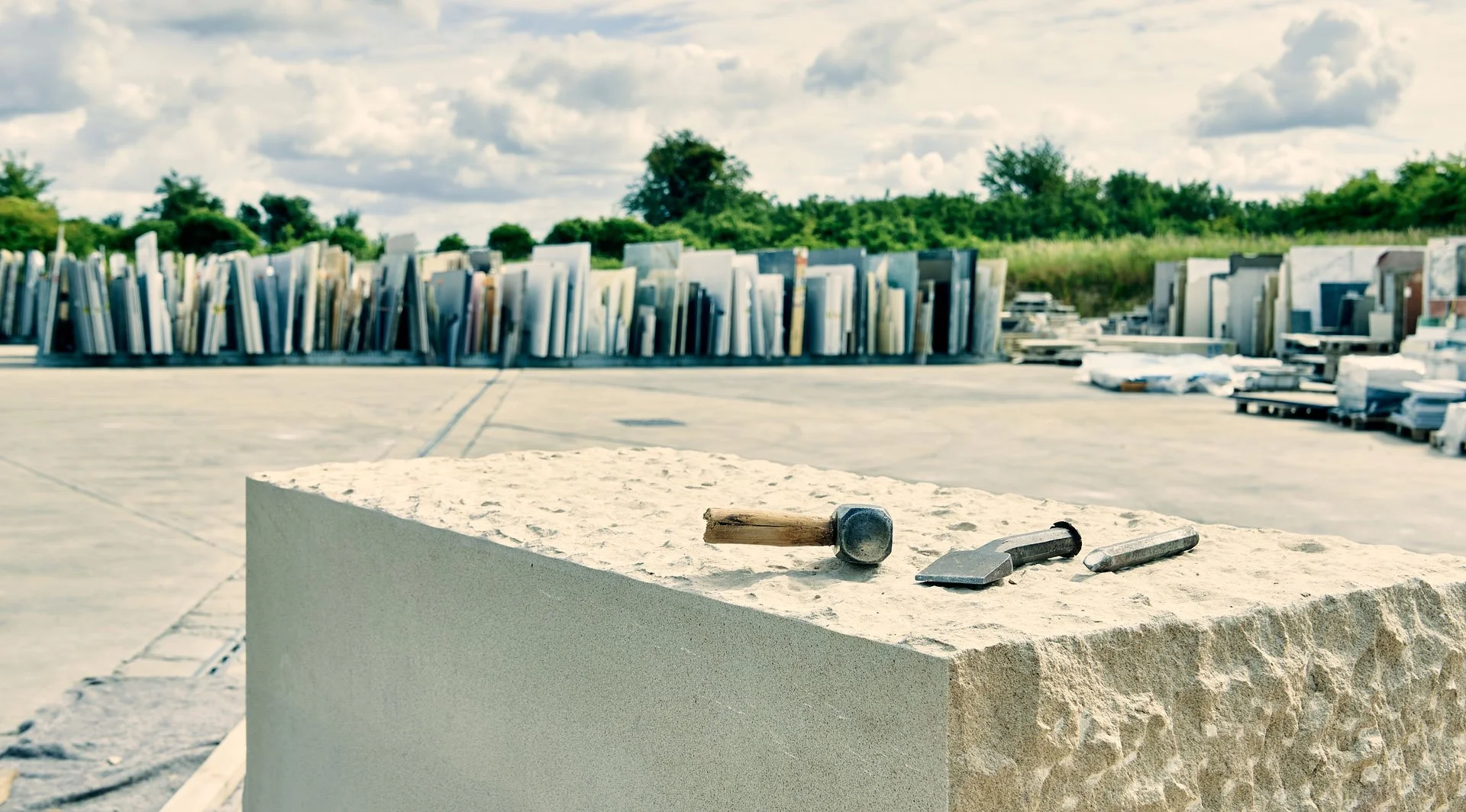

How to approach stone selection for commercial interiors
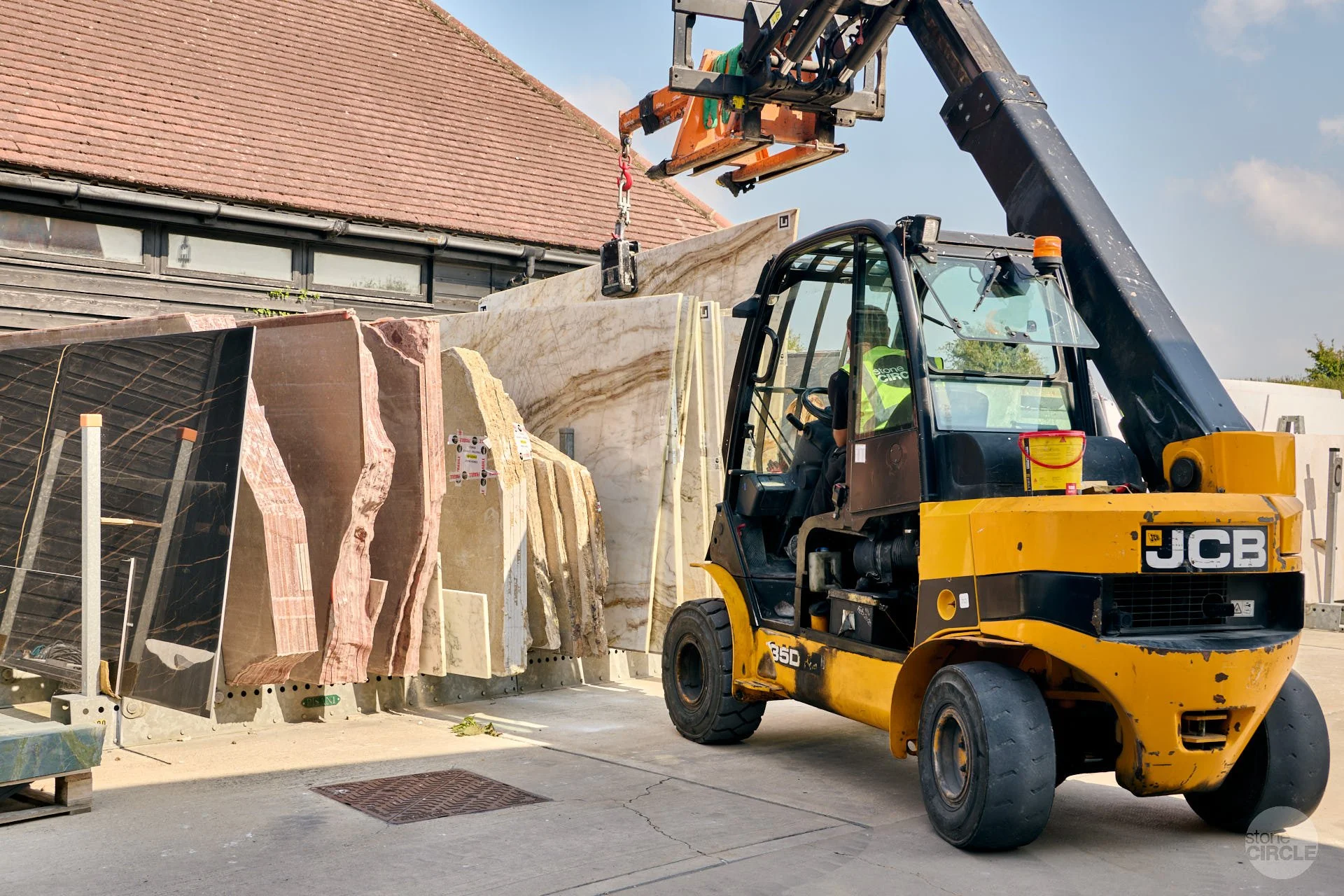
Stone selection begins with beauty, but commercial interiors require performance, scale and practicality too.
Natural stone carries particular authority in commercial interiors. It lends weight to a reception desk, permanence to a lobby, richness to a bathroom, presence to a bar, and tactility to surfaces people touch every day.
But choosing stone for a commercial project is not simply a matter of selecting a beautiful slab.
The right material has to work aesthetically, technically, commercially and practically. It has to suit the design intent, perform in its intended location, meet programme requirements and withstand the realities of public or semi-public use.
At stoneCIRCLE, we are often asked to help contractors, designers, architects, and clients move from an initial design idea to a stone package that can be successfully fabricated, installed, and maintained. The earlier this conversation happens, the better the result.
On larger commercial surfaces or hospitality interiors, pattern, scale and slab sequencing can define the final result.
Start with the purpose of the space
A hotel lobby, luxury retail counter, restaurant bar, office reception, spa bathroom and private members’ club each place different demands on stone.
Some spaces are about making an immediate visual impression. Others need subtle durability. Some surfaces will be touched constantly; others are seen from a distance. Floors, vanity tops, wall cladding, staircases, bars and furniture pieces all require different considerations.
Before choosing the material, it is worth asking:
What role does the stone play in the design?
Is it a focal point or a quiet background surface?
Will it be touched, walked on, leaned against, cleaned daily, or exposed to water?
Does it need to feel luxurious, calm, dramatic, traditional, contemporary, or highly individual?
These questions help narrow the choice before colour and pattern take over the conversation.
Beauty is only one part of suitability
Natural stone is chosen for its beauty, but not every beautiful stone suits every commercial application.
Marble, limestone, granite, quartzite, travertine, onyx and composite materials all behave differently. Some are harder, some more porous, some more resistant to staining, and some better suited to vertical cladding than to heavy-use horizontal surfaces.
A heavily veined marble may be perfect for a feature wall or reception counter, but less suitable for a surface exposed to constant spills unless the client accepts the maintenance implications. A limestone may bring warmth and softness to an interior, but it needs to be selected and finished with its intended use in mind. Quartzite can offer exceptional hardness and dramatic natural movement, while sintered and composite materials may be useful where consistency and performance are priorities.
The best choice is rarely just “the most beautiful stone”. It is the stone that delivers the intended effect and performs realistically in its setting.
Colour and veining are only the beginning. Each stone must be considered for its intended use.
Bars, counters and reception desks require stone that balances visual impact with everyday use.
Consider finishing as carefully as the material
The surface finish can completely change a stone’s character and performance.
Polished marble reflects light and creates a sense of elegance, but it may not be suitable in every setting. A honed finish can feel more contemporary and understated. A leathered or textured finish can add depth and tactility. In some areas, slip resistance, cleaning requirements and wear patterns must be considered from the outset.
Finishes should not be treated as an afterthought. They affect appearance, touch, maintenance and long-term behaviour.
For commercial interiors, range samples are essential: not only small material samples but also, where possible, representative samples that show the proposed finish, edge detail, thickness, and fixing approach.
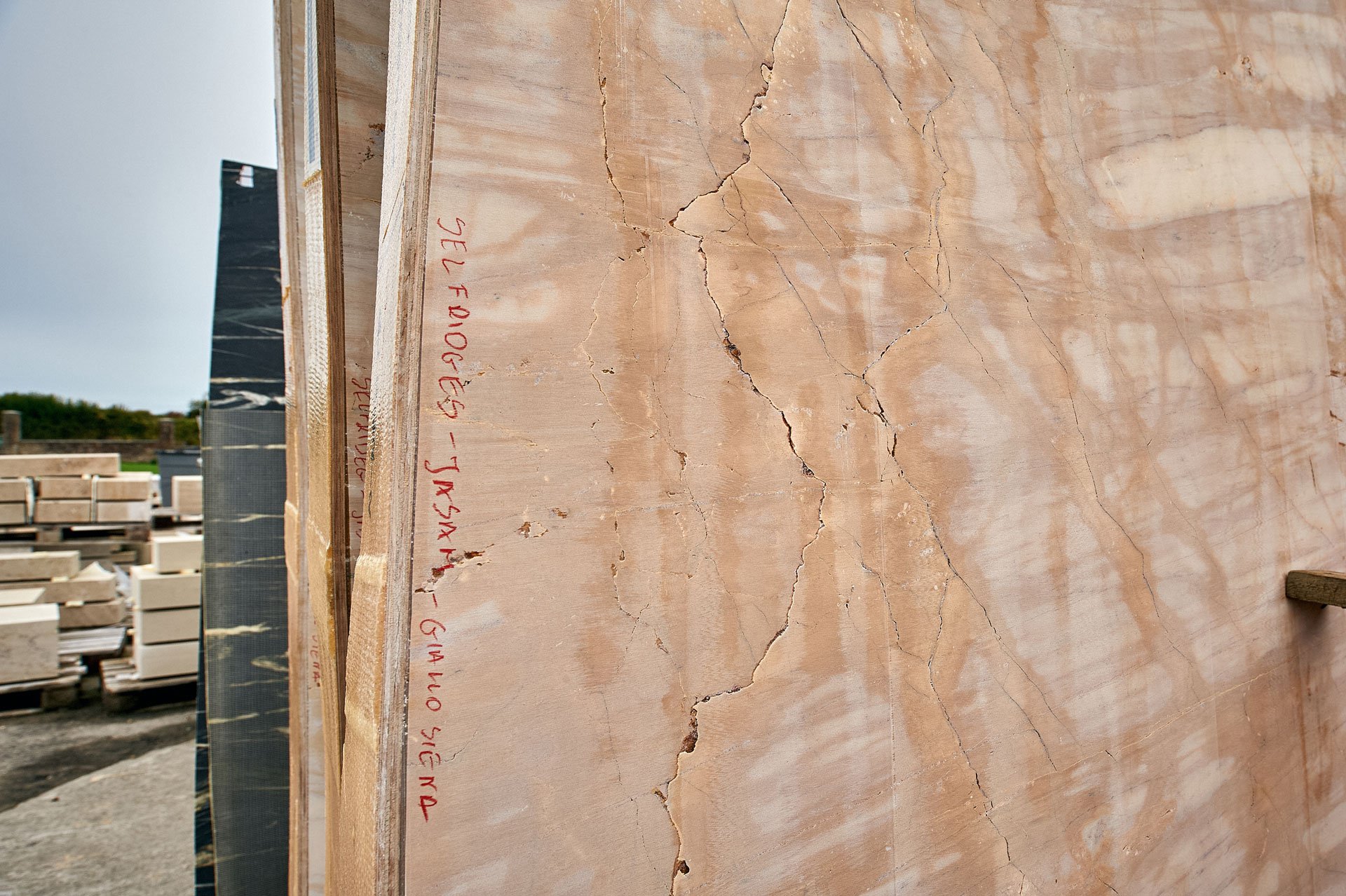
Giallo Siena marble slab pre-selected for a hospitality project in London.
Think about scale, pattern and availability
A stone that looks exceptional in a small sample may behave very differently across a large wall, a long bar, or repeated vanity installations.
Commercial interiors often require consistency across multiple pieces, careful vein matching, bookmatching, slab sequencing, or repeated cutting from the same batch. Availability, lead times, and waste factors matter. Replacement pieces may also need to be considered.
This is where early professional input is valuable. A fabricator can advise on whether the selected material is available in the right quantity and format, whether the proposed design suits the slab sizes, and how the stone can be cut to achieve the best visual result.
In premium interiors, the difference between good and exceptional often lies in these decisions.
CNC gives accuracy; hand finishing refines the final surface, edge and detail.
Involve the fabricator before the design is fixed
Many stone challenges arise when a material is selected, drawn and specified before anyone has checked how it will be made.
Early collaboration can help avoid problems with weight, thickness, support, access, fixing, joint positions, edge details, tolerance, transport and installation sequence.
At stoneCIRCLE, our role is often to bridge the gap between design ambition and practical delivery. Our CNC machinery, waterjet cutting, 3D modelling and hand-finishing skills allow us to produce complex work, but the best results come when fabrication knowledge is built into the design process early.
This does not limit creativity. It protects it.
Maintenance should be part of the specification
Every material decision has maintenance implications.
Commercial clients need to understand how a surface will age, how it should be cleaned, whether it needs sealing, and which substances may mark or damage it. This is particularly important in hospitality, bathrooms, spas, restaurants and retail environments, where cleaning regimes can be frequent and sometimes aggressive.
The aim is not to discourage the use of natural stone. It is to ensure the selected stone is used knowingly and properly maintained.
A well-chosen and well-maintained stone surface can last for decades. A poorly matched material in the wrong application can disappoint very quickly.
In hospitality and bathroom environments, stone selection must consider cleaning, water exposure and maintenance.
The right stone balances design, performance and delivery
Stone selection for commercial interiors ultimately balances four factors:
Design intent.
Material performance.
Fabrication feasibility.
Long-term maintenance.
When these are considered together, stone can do what it has always done best: give a space permanence, atmosphere and distinction.
stoneCIRCLE has been working with natural stone and composite materials since 1968, combining traditional masonry skills with advanced CNC technology and hand finishing. We work with contractors, designers, architects, artists and private clients to help turn ambitious stone ideas into finished work that can be made, installed and enjoyed with confidence.
For advice on stone selection for a commercial project, please contact our team or visit our Basingstoke showroom and stone yard.